





Indonesia’s Digital SEZ in 2026: The New Frontier for Tech, Data Centers, and the Creative Economy
4 月 13, 2026
•
阅读时间:8分钟
内容
Why the World Is Watching Indonesia’s Digital SEZ Landscape Right Now
A quiet transformation is underway across Southeast Asia, and Indonesia is at the center of it. As companies around the world scramble to expand digital infrastructure, secure data center capacity, and access fast-growing consumer markets, the Indonesia digital SEZ has emerged as one of the most strategically compelling investment destinations in the region.
For foreign businesses — including tech companies, healthcare innovators, digital infrastructure providers, and creative economy players — understanding Indonesia’s Special Economic Zones (SEZs) is no longer optional. It is becoming a core part of any serious Southeast Asia market entry strategy.
This article breaks down what Indonesia’s digital SEZs offer in 2026, which zones deserve the most attention, and why the opportunity window is open right now.
What Is an Indonesia Digital SEZ, and Why Does It Matter?
A Special Economic Zone, or SEZ, is a designated geographic area where the government offers a distinct set of legal, fiscal, and operational advantages to attract investment. Indonesia has been operating SEZs for years, but its newer generation of digital-focused zones represents a fundamental shift in strategy.
Unlike traditional SEZs built around manufacturing or commodity exports, an Indonesia digital SEZ is designed to attract knowledge-based businesses: software developers, data center operators, healthtech firms, edtech platforms, digital animation studios, and creative economy enterprises. These zones come with purpose-built infrastructure, streamlined licensing, and investor-friendly regulations that are simply not available in standard commercial locations.
For international companies, the practical benefits are significant. Business setup within an Indonesia digital SEZ is faster and more straightforward than navigating the standard domestic licensing process. Foreign investors gain access to long-term tax holidays, import duty exemptions on critical equipment, and expedited visa pathways for foreign technical staff. All of this makes the Indonesia digital SEZ ecosystem one of the most attractive in all of ASEAN.
Nongsa Digital Park, Batam: The Flagship Indonesia Digital SEZ for Regional Connectivity
When investors talk about a tech hub Indonesia strategy in 2026, Nongsa Digital Park (NDP) in Batam consistently sits at the top of the list. Its appeal comes down to geography, infrastructure, and a proven track record.
The Singapore Arbitrage: ASEAN’s Most Valuable Location Advantage
Batam is part of Indonesia but sits just 45 minutes by ferry from Singapore’s harbour. That proximity creates a unique dynamic in the region. Companies operating within Nongsa Digital Park can access Singapore’s financial services, legal infrastructure, and global client networks while running their core operations at Indonesian cost levels.
Office space, land, and labour costs in Batam can be 60 to 70 percent lower than equivalent costs in Singapore. High-speed submarine cables connect the Nongsa Digital Park directly to Singapore’s internet backbone, meaning there is no compromise on connectivity. For any business requiring both regional credibility and cost efficiency, this combination is difficult to replicate anywhere else in Southeast Asia.
Nongsa Digital Park Investment: Four New Data Centers on the Way
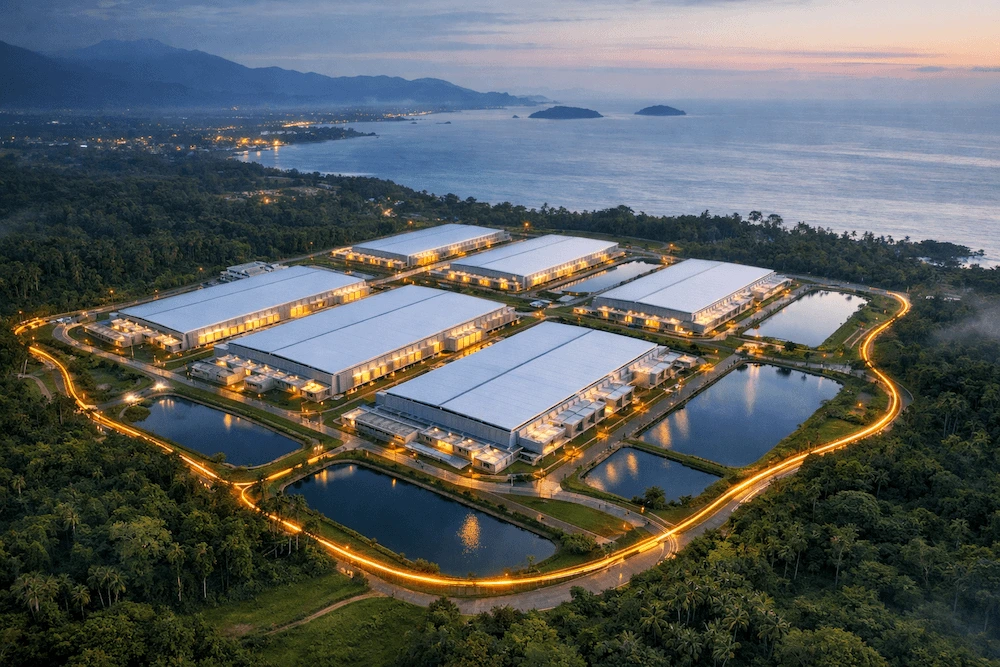
Demand for Nongsa Digital Park investment has grown so rapidly that the zone has reached its existing land capacity. According to Antara News, NDP is currently expanding its footprint with plans to build four new data centers to meet this demand. This is not speculative pipeline — it reflects the real-world pressure of a zone that has filled up because it works.
For companies evaluating a data center Indonesia SEZ strategy, this expansion signals both the strength of current demand and the government’s commitment to scaling supply. The pipeline of new infrastructure at Nongsa represents a significant addition to Indonesia’s total digital capacity.
Who Is Already Operating at Nongsa?
The existing tenant base at Nongsa Digital Park spans technology companies, digital animation studios, e-commerce operations, software development centers, and data infrastructure providers. Many serve both the Indonesian domestic market and clients based in Singapore, creating a dense network of cross-border digital activity. This cluster effect is valuable: it attracts more talent, generates knowledge transfer, and creates conditions for follow-on investment from suppliers, service providers, and partners.
D-HUB SEZ, BSD City: The Indonesia Digital SEZ Built for Jakarta’s Economy
While Nongsa captures the Singapore connectivity opportunity, D-HUB SEZ in BSD City, South Tangerang, is designed around a different thesis: proximity to Jakarta, one of the largest consumer and business markets in Southeast Asia.
D-HUB is explicitly structured around four focus areas: digital technology, healthcare technology, education, and the creative economy. This design reflects a deliberate shift in Indonesia’s investment strategy toward higher-value, knowledge-based sectors rather than traditional manufacturing.
Why Healthtech and Medtech Companies Should Pay Attention
The inclusion of healthcare technology as a core D-HUB focus area is significant for foreign medical device manufacturers and healthcare companies considering Southeast Asia expansion. Companies looking for a regulated, incentivised environment in which to establish distribution, assembly, or regional headquarters operations will find that D-HUB’s sector focus aligns directly with the healthtech and medtech space.
Indonesia’s domestic healthcare market is growing rapidly, driven by a population of 280 million people, rising middle-class demand, and substantial government investment in health infrastructure. A business setup inside the D-HUB Indonesia digital SEZ positions healthcare companies at the centre of this growth, with access to a large domestic market and a purpose-built regulatory environment designed to attract foreign investment.
Core Advantages of Operating Inside an Indonesia Digital SEZ
The case for locating within an Indonesia digital SEZ goes well beyond tax incentives, though those are substantial. The full package addresses the most common friction points that slow foreign businesses down during market entry.
Tax holidays with long duration. Qualifying investments in an Indonesia digital SEZ can access corporate income tax holidays ranging from 10 to 20 years, depending on the investment size and zone classification. This is among the most competitive tax holiday frameworks in all of ASEAN, outpacing comparable programmes in Vietnam, Malaysia, and Thailand.
Import duty exemptions. Servers, networking equipment, and capital goods imported for use within a digital SEZ qualify for import duty exemptions. For data center operators and technology infrastructure businesses, this directly reduces the cost of building and maintaining capacity.
Expedited work permits and multi-entry visas. Digital SEZs offer fast-track visa pathways for foreign engineers, developers, and technical specialists. This removes one of the most common operational bottlenecks for international companies scaling up a local team.
Geological stability for data center uptime. Both Batam and BSD City sit in geologically stable corridors, which matters significantly for data center operators who require guaranteed uptime. Low seismic risk is a meaningful operational advantage in a region where infrastructure resilience is a primary concern.
Singapore connectivity at Indonesian cost. For Batam-based operations specifically, the ability to access Singapore’s networks and client base while operating at Indonesian cost levels is a competitive advantage that no other location in ASEAN fully replicates.
Indonesia vs. Regional Competitors: An Honest Comparison
Foreign investors naturally compare Indonesia against Vietnam, Malaysia, and Thailand when deciding where to place digital operations. Each country has genuine strengths, and the right answer depends on specific business objectives.
Indonesia’s advantages are most pronounced in three areas. First, market size: with 280 million people, Indonesia is by far the largest domestic market in Southeast Asia, which matters for any business targeting regional consumers or building regional distribution infrastructure. Second, tax holiday duration: Indonesia’s up-to-20-year corporate income tax holiday exceeds the equivalent programmes offered by Vietnam (up to 15 years), Thailand (up to 13 years), and Malaysia (up to 10 years). Third, the Singapore arbitrage: no other country in the region offers the same combination of Singapore proximity and Indonesian cost structure that Batam provides through the Nongsa Digital Park investment ecosystem.
Vietnam offers strong tech talent pipelines and competitive costs. Malaysia provides strong English-language infrastructure and an established financial services sector. Thailand has a developed logistics network and strong tourism-linked digital economy. But for companies seeking maximum market scale, long-term fiscal certainty, and ASEAN regional connectivity, the Indonesia digital SEZ offering in 2026 is difficult to match.
What Is Coming Next: The Indonesia Digital SEZ Pipeline for 2026 and Beyond
Indonesia is not standing still. The government is actively developing new zones and expanding existing ones to meet demand that has already outpaced current capacity.
The Nongsa expansion in Batam will add four new data centers, significantly increasing the total infrastructure footprint of the zone and creating new co-location and connectivity opportunities for existing and incoming tenants. D-HUB SEZ in BSD City is progressing through formal development stages, with its focus on digital tech, healthcare, education, and the creative economy designed to attract knowledge-economy businesses near Jakarta’s consumer base.
Beyond these two flagship zones, the government is exploring additional creative and digital economy corridors in key growth regions, and expanding support for green data center development to attract ESG-aligned capital. Investors interested in sustainable digital infrastructure will find growing openness at both central government and SEZ administrator level.
Navigating Business Setup in an Indonesia Digital SEZ
For foreign companies beginning the process of business setup in an Indonesia digital SEZ, the pathway is more structured than a standard market entry but also more supportive. SEZ administrators typically provide dedicated investment facilitation services, including guidance on entity type, licensing requirements, and available incentive packages.
Key steps include identifying the most appropriate zone based on sector and geographic fit, engaging with the relevant SEZ administrator and the Indonesia Investment Coordinating Board (BKPM), structuring the legal entity appropriately for the intended activities, and applying for the relevant tax holiday and incentive facilities. Given the legal complexity involved, working with qualified local counsel throughout this process is strongly recommended.
Conclusion: The Indonesia Digital SEZ Window Is Open
The case for investing in an Indonesia digital SEZ in 2026 rests on fundamentals that are difficult to argue with. A market of 280 million people. Among the fastest-growing internet usage in the world. Purpose-built digital zones with long-term tax holidays, import duty exemptions, and operational infrastructure that removes standard market entry friction. And a unique geographic arbitrage through Batam that gives companies access to Singapore’s networks at Indonesian cost levels.
For tech companies, data center operators, healthtech manufacturers, edtech platforms, and creative economy businesses, the Indonesia digital SEZ ecosystem represents one of the most compelling business setup opportunities in the region right now. The demand pipeline is clear, the infrastructure investment is underway, and the policy direction is consistent. The question for serious investors is not whether Indonesia belongs in their Southeast Asia strategy. It is how quickly they can move to secure their position.
联系我们的团队
请让我们知道我们如何协助您的公司成立或扩张。
自信地进入东南亚市场
亚洲商业中心随时准备帮助您了解印度尼西亚、越南和菲律宾的法规,涵盖从营业执照、产品注册到劳动力管理等各个方面。我们采用高效、准确且以业务为中心的方法。
免责声明
本网站提供的内容由 PT. Bisnis Hub Asia (“我们“, 或者 ”我们”)仅供一般参考之用。尽管我们已尽一切努力确保所提供信息的准确性和及时性,但我们不对本网站所述任何内容、产品或服务的完整性、准确性、可靠性、适用性或可用性作出任何明示或暗示的陈述或保证。任何依赖此类信息的风险均由用户自行承担。
我们是一家 私人、独立实体 并且 不隶属于, 授权, 或者 代表 印度尼西亚共和国政府、其各部委、机构或任何官方指定的代表。本网站不 不是 提供、提供或推广任何官方政府文件或服务,包括但不限于:
企业识别号(Nomor Induk Berusaha – NIB);
退税或返还;
居留许可或电子旅行授权;
护照或其他与移民相关的文件。
对此类服务的任何引用仅供一般参考,不应被视为官方服务的提供或便利。
我们致力于确保按照以下规定保护您的个人数据 2022年第27号《个人数据保护法》任何通过本网站收集的个人信息,都将按照我们[隐私声明]中明确规定的用途进行处理。在任何情况下,我们都不会出售或滥用个人信息。
访问并使用本网站,即表示您确认并同意本免责声明中所列的条款。您进一步同意以负责任的方式使用本网站及其所提供的信息,并遵守适用的法律法规。
如需了解有关本免责声明的更多信息或有任何疑问,请通过我们的联系页面提供的渠道与我们联系。
你可能还喜欢
随时了解我们关于在东南亚开展业务的最新见解、指南和文章。
营业执照
Ensuring Compliance: How to Transition Your Business to KBLI 2025

Tjhia Edy Tarlesno, SH, LLM. • 6 月 24, 2026
营业执照
Indonesia Business License After NIB: What You Still Need to Operate Legally

Fahri Ramanda Putra • 5 月 25, 2026
营业执照
How to Start a Fintech Company in Indonesia: The Complete Guide for Foreign Investors
Fahri Ramanda Putra • 5 月 8, 2026